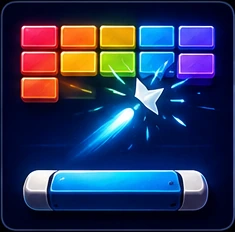
Breakout strategy guide
Break armored brick rows, catch paddle power-ups, and turn multi-ball windows into a fast full-wall clear.
Classic
3-8 min rounds
Breakout now has enough systems that the wall itself becomes a routing problem. Armor depth, power-up choice, and whether you protect control or gamble for tempo all matter before the last brick falls.
What changed in this build
The field has expanded to 18 by 12 bricks, with normal rows now mixed with 2-hit, 3-hit, and 5-hit armor. Speed, slow, and curve bricks bend the rally in different directions, while wide paddle, multi-ball, piercing, and extra-life drops give the round much more shape than the older straight-line version.
How scoring and progress work
- The round only ends when the whole wall is gone, but the pace depends on which lanes you open first. Top-row mega bricks take longest, yet breaking them early creates cleaner rebound routes for the rest of the board.
- Multi-ball is almost pure upside because you only lose a life when every ball drops. Piercing is the opposite kind of value: short, explosive windows that convert one good angle into a fast lane through dense clusters.
How to push stronger runs
- Play for ceiling access early. Once the ball starts living above the middle rows, even armored bricks begin to disappear faster because the return angles stay productive.
- Catch power-ups on purpose, not automatically. A badly timed pickup can drag the paddle off the return line and cost more control than the bonus was worth.
Common mistakes to avoid
- Following every bounce too late and arriving under the ball with no angle left to shape.
- Treating multi-ball like panic instead of using the extra balls to finish stubborn armor while your life counter is still safe.
Breakout FAQ
These answers focus on the new systems that most often change how the run actually feels, not on filler definitions.
Does multi-ball consume extra lives?
No. You only lose a life when the last active ball falls, which is why multi-ball is usually a tempo gain instead of a risk multiplier.
How can you tell when armored bricks are close to breaking?
This build uses crack density and darkening instead of numbers. If a brick looks more fractured and less bright, it is already near its last hit.
Similar games
Up next
Try a different mood, keep the streak alive.

Drone Soccer 3D
75-120 sec matches
Pilot a striker drone through tighter scoring rings, beat active AI defenders, and chase a World Cup-style 3D aerial soccer win.
Arcade
Play
Foosball 3D
60-150 sec matches
Play a fast 3D foosball game online. Drag the rods, tap to shoot, use rebounds, and beat the AI in a World Cup-style table football match.
Classic
Play

Soccer Brawl 3D
90 sec matches
Play chaotic 4v4 street soccer with chibi players, wild charged shots, airborne tackles, and day or night weather.
Arcade
Play

Circuit Workshop
30 sec-2 min puzzles
Try a different vibe. Tap to play instantly.
Logic
Play

TileTown Planner
3-8 min town plans
Plan a compact isometric town, spend budget wisely, connect buildings to roads, and finish each challenge with a star rating.
Logic
Play

Space Invaders Lite
2-6 min runs
Clear alien waves, collect upgrade drops, hunt UFO bonuses, and build combos before the fleet crushes your lane.
Classic
Play